I. The Plucked String Instruments
-
The Lute family
-
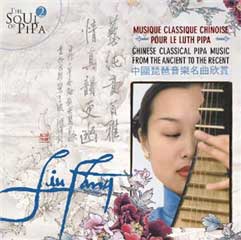
 Pipa
(
Pipa
(  pi-pa
or p'i-p'a) - four-stringed lute with 30 frets and pear-shaped
body. The instrumentalist holds the pipa upright and play
with five small plectra attached to each finger of the right
hand. The pipa history can be dated back at least 2000 years
and developed from pentatonic to full scales. This instrument
has extremely wide dynamic range and remarkable expressive
power. (more
about pipa ... ) pi-pa
or p'i-p'a) - four-stringed lute with 30 frets and pear-shaped
body. The instrumentalist holds the pipa upright and play
with five small plectra attached to each finger of the right
hand. The pipa history can be dated back at least 2000 years
and developed from pentatonic to full scales. This instrument
has extremely wide dynamic range and remarkable expressive
power. (more
about pipa ... )  
-
Liuqin
(  )
-a smaller version of pipa with four strings, which sound
similar to mandolin. Liuqin is played with a piece of spectrum,
and is used to be accompany instrument for folk songs and
local opera. However, in recent decades, Composer Wang
Huiran made great contribution to its making and composed
many pieces such that the Liuqin also becomes a soloist instrument. )
-a smaller version of pipa with four strings, which sound
similar to mandolin. Liuqin is played with a piece of spectrum,
and is used to be accompany instrument for folk songs and
local opera. However, in recent decades, Composer Wang
Huiran made great contribution to its making and composed
many pieces such that the Liuqin also becomes a soloist instrument.
-
Sanxian
(  )-
A long necked lute with three strings without frets. In Chinese,
"san" and "xian" stands for " "three" and "strings", respectively.
The sound-body is made of round wooden box covered with snake
skin, just like erhu. A piece of plectrum is used to play
the instrument. This instrument is often used for accompanying
folk songs and local opera. The sanxian is most popular in
the north. )-
A long necked lute with three strings without frets. In Chinese,
"san" and "xian" stands for " "three" and "strings", respectively.
The sound-body is made of round wooden box covered with snake
skin, just like erhu. A piece of plectrum is used to play
the instrument. This instrument is often used for accompanying
folk songs and local opera. The sanxian is most popular in
the north.
-
Ruan
( )-
commonly referred to as "Chinese guitar", is an
ancient four-stringed moon-shaped lute with long and straight
neck and various number of frets, dated back at least to Qin
Daynasty (around 200 BC). Ruan is used to )-
commonly referred to as "Chinese guitar", is an
ancient four-stringed moon-shaped lute with long and straight
neck and various number of frets, dated back at least to Qin
Daynasty (around 200 BC). Ruan is used to  be
called "p'i-p'a" (pipa)
or qin-pipa. Since the introduction of the oud-like instrument
through the "silk-road" around 5th century, a new type of
"pipa" with pear-shaped body and bent neck has been
gradually developed into the present form since the Tang Dynasty
(618-917AD), and the name pipa,
which used to be a generic term for all pluck string lutes,
has been specifically given to this newly-developed version,
whereas the old form of pipa with straight-neck and
round body got the name "Ruan", after the name of the grand
master of this instrument, Ruan
Xian who was one of the seven great scholars known as
"Seven Sages of the Bamboo Grove" in Chinese history of the
3rd century (the Six Dynasties). They were truely good friends
and did spend much time together in arts and wine during one
of the darkest periods in Chinese history. be
called "p'i-p'a" (pipa)
or qin-pipa. Since the introduction of the oud-like instrument
through the "silk-road" around 5th century, a new type of
"pipa" with pear-shaped body and bent neck has been
gradually developed into the present form since the Tang Dynasty
(618-917AD), and the name pipa,
which used to be a generic term for all pluck string lutes,
has been specifically given to this newly-developed version,
whereas the old form of pipa with straight-neck and
round body got the name "Ruan", after the name of the grand
master of this instrument, Ruan
Xian who was one of the seven great scholars known as
"Seven Sages of the Bamboo Grove" in Chinese history of the
3rd century (the Six Dynasties). They were truely good friends
and did spend much time together in arts and wine during one
of the darkest periods in Chinese history. 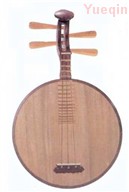 Ruan
Xian and Ji
Kang (master of guqin,
Chinese 7-stringed zither), are most famous for their musical
achievements and the life as true artists. The Ruan is mostly
used for Peking opera, and now also in modern Chinese orchestra.
There are a family of ruan of various size including "Zhong
Ruan" (middle Ruan) and "Da Ruan" (large Ruan) used in the
same sense as viola and cello in western orchestra. Ruan
Xian and Ji
Kang (master of guqin,
Chinese 7-stringed zither), are most famous for their musical
achievements and the life as true artists. The Ruan is mostly
used for Peking opera, and now also in modern Chinese orchestra.
There are a family of ruan of various size including "Zhong
Ruan" (middle Ruan) and "Da Ruan" (large Ruan) used in the
same sense as viola and cello in western orchestra.
- Yueqin
(
 )-
moon-shaped lute with shorter neck and four strings, played
with a spectrum, used for accompanying local operas. "Yue" stands
for "the moon" in Chinese. )-
moon-shaped lute with shorter neck and four strings, played
with a spectrum, used for accompanying local operas. "Yue" stands
for "the moon" in Chinese.
-
The zither family
-
Guqin
( )
- seven-stringed zither without bridges, the most classical )
- seven-stringed zither without bridges, the most classical
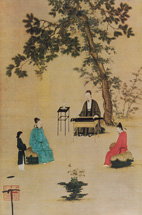 Chinese instrument with over 3000 years of history. The
guqin is
Chinese instrument with over 3000 years of history. The
guqin is  often
referred to as the instrument of sages for the purpose of
enriching the heart and elevating human spirit.
Confucius
(around 600 BC) was a master of this instrument. In the Imperial
China's past, well-educated people of the elite society were
expected to master the four arts, namely, the qin (guqin),
qi (weiqi, which has somehow been known as "Go"
in the West according Japanese pronuciation), shu (Calligraphy),
and hua (painting). Being on top of the four traditional arts,
the guqin has historically been regarded as one of the most
important symbols of Chinese high culture. Unfortunately only
small number of people in China could play the instrument,
because classical musical education of this kind has never
reached general public. Fortunately, the situation has much
been improved in recent decades, there have been a growing
number of guqin players both in and outside China. Since november
2003, Guqin has been registered as one of the master pieces
of the Oral and Intangible Heritage of the humanity by UNESCO
(more information...) often
referred to as the instrument of sages for the purpose of
enriching the heart and elevating human spirit.
Confucius
(around 600 BC) was a master of this instrument. In the Imperial
China's past, well-educated people of the elite society were
expected to master the four arts, namely, the qin (guqin),
qi (weiqi, which has somehow been known as "Go"
in the West according Japanese pronuciation), shu (Calligraphy),
and hua (painting). Being on top of the four traditional arts,
the guqin has historically been regarded as one of the most
important symbols of Chinese high culture. Unfortunately only
small number of people in China could play the instrument,
because classical musical education of this kind has never
reached general public. Fortunately, the situation has much
been improved in recent decades, there have been a growing
number of guqin players both in and outside China. Since november
2003, Guqin has been registered as one of the master pieces
of the Oral and Intangible Heritage of the humanity by UNESCO
(more information...)
-
Zheng
( )
or Guzheng
()-
Chinese zither with movable bridges and 16 - 25 strings. In
the same family there are the Japanese koto, the Vietnamese
dan tranh, the Korean kayagum, and the Mongolian
Yagta (more information...
) )
or Guzheng
()-
Chinese zither with movable bridges and 16 - 25 strings. In
the same family there are the Japanese koto, the Vietnamese
dan tranh, the Korean kayagum, and the Mongolian
Yagta (more information...
)
-
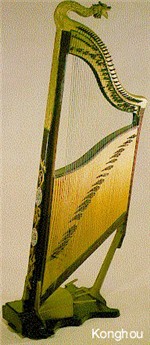
The harp family
II. The Bowed String Instruments:
The
huqin family
-
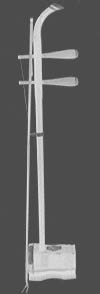
Erhu
(  )-
or Er-Hu, a two-stringed fiddle, is one of the most popular Chinese
instruments in the Hu-qin ()
family, where
Hu stands for "foreign" or "the northern folk" in Chinese, and
"qin" is a general name for all kinds of string instruments. (more
information about Erhu ...). )-
or Er-Hu, a two-stringed fiddle, is one of the most popular Chinese
instruments in the Hu-qin ()
family, where
Hu stands for "foreign" or "the northern folk" in Chinese, and
"qin" is a general name for all kinds of string instruments. (more
information about Erhu ...).
-
Zhong-Hu
( ):
If we call the "Erhu" Chinese violin, the Zhong-Hu is then the
Chinese viola, where "Zhong" stands for "middle", thus the abbreviated
name for the mid-pitched Erhu. It was developed on the basis of
Erhu in the 1940s. Both the structure and performing skill of
these two kinds of Hu-Qin are quite the same, yet Zhong-Hu has
a deeper-sounding timbre but not as agile. Being more suitable
for singing melodies (particularly some Mongolian melodies), Zhong-Hu
is thus often used as tutti or accompanying instruments, sometimes
for solo too. ):
If we call the "Erhu" Chinese violin, the Zhong-Hu is then the
Chinese viola, where "Zhong" stands for "middle", thus the abbreviated
name for the mid-pitched Erhu. It was developed on the basis of
Erhu in the 1940s. Both the structure and performing skill of
these two kinds of Hu-Qin are quite the same, yet Zhong-Hu has
a deeper-sounding timbre but not as agile. Being more suitable
for singing melodies (particularly some Mongolian melodies), Zhong-Hu
is thus often used as tutti or accompanying instruments, sometimes
for solo too.
-
Jing-Hu
( ):
Principally used as accompanying instrument for Beijing Opera,
Jing-Hu is another important two-stringed fiddle in the Huqin
family. It was developed in Qin dynasty ( around 1790 ), which
is often called the Hu-Qin. The pitch of Jing-Hu is the highest
among all instruments of the Hu-Qin family. Due to its forceful
and clarion timbre, Jing-Hu is suitable almost exclusively for
Beijing opera. ):
Principally used as accompanying instrument for Beijing Opera,
Jing-Hu is another important two-stringed fiddle in the Huqin
family. It was developed in Qin dynasty ( around 1790 ), which
is often called the Hu-Qin. The pitch of Jing-Hu is the highest
among all instruments of the Hu-Qin family. Due to its forceful
and clarion timbre, Jing-Hu is suitable almost exclusively for
Beijing opera.
-
Ban-Hu
( ):
Ban-Hu has many other names such as Pang-Hu, Qin-Hu, Hu-Hu and
Da-Xian, etc. It is the leading accompanying instrument for Bang-Zi
and other northern tunes or ballads, particularly for the local
operas in Henan Province, central China. Similar to Jing-Hu, the
timbre of Ban-Hu is clarion and bright, which makes it hard to
join other instruments for tutti. Therefore it's usually for solo,
especially for presenting joyful and passionate moods. ):
Ban-Hu has many other names such as Pang-Hu, Qin-Hu, Hu-Hu and
Da-Xian, etc. It is the leading accompanying instrument for Bang-Zi
and other northern tunes or ballads, particularly for the local
operas in Henan Province, central China. Similar to Jing-Hu, the
timbre of Ban-Hu is clarion and bright, which makes it hard to
join other instruments for tutti. Therefore it's usually for solo,
especially for presenting joyful and passionate moods.
-
Gao-Hu
( ),
also called High-pitched Erhu or Yue-Hu, is especially designed
for playing Cantonese folk melodies and operas. Gao-Hu is often
used for performing vivid and brisk rhythms, particularly for
higher-pitched tunes that Erhu cannot play. In comparison with
Erhu, Gao-Hu has louder volume yet brighter tones, and thus it
servers both as solo and leading instrument in performing Cantonese
operas and folk melodies. ),
also called High-pitched Erhu or Yue-Hu, is especially designed
for playing Cantonese folk melodies and operas. Gao-Hu is often
used for performing vivid and brisk rhythms, particularly for
higher-pitched tunes that Erhu cannot play. In comparison with
Erhu, Gao-Hu has louder volume yet brighter tones, and thus it
servers both as solo and leading instrument in performing Cantonese
operas and folk melodies.
- Yehu
(
 ):two
stringed bowed instrument similar to erhu, however, with a coconut
sound body where Ye means coconut. It is found mostly in South China
and Taiwan. ):two
stringed bowed instrument similar to erhu, however, with a coconut
sound body where Ye means coconut. It is found mostly in South China
and Taiwan.
-
Sihu
( ):
four stringed huqin used for accompanying local opera, most commonly
found in the North, such as Sanxi, Shanxi and Neimonggu. It is
one of the three leading instruments (together with dizi, yangqin)
in "Er Ren Tai" of Neimonggu (Inner Mongolia). "Si" stands for
"four" in Chinese. The structure is similar to Erhu except it
has four strings. The horse-hair of the bow is divided into two
group that go between the four strings. ):
four stringed huqin used for accompanying local opera, most commonly
found in the North, such as Sanxi, Shanxi and Neimonggu. It is
one of the three leading instruments (together with dizi, yangqin)
in "Er Ren Tai" of Neimonggu (Inner Mongolia). "Si" stands for
"four" in Chinese. The structure is similar to Erhu except it
has four strings. The horse-hair of the bow is divided into two
group that go between the four strings.
- Zhuihu(
 ),
also known as Zhuiqin, is
one of the most popular instruments in Henan and Shandong Provinces,
used for local opera and story-telling. The instrument was invented
toward the end of Qing Dynasty (1644 to 1912) based on the pluck
string Sanxian and bowed string erhu. The striking difference from
Erhu is that Zhuihu has a fretless
fingerboard similar to Sanxian. The use of the bow is similar to
that of erhu. Basically
the instrument is derived from a smaller version of Sanxian performed
with a bow, producing beautiful sounds with a strong local flavour,
capable of imitating a lot of natural sounds such as birds and horse
etc. The playing methods adapt the left hand techniques for the
Sanxian and the bow techniques of erhu.
The Zhuihu is one of the most beautiful instruments of the
huqin family, which has become very popular soon after its invention
in Henan and Shandong. ),
also known as Zhuiqin, is
one of the most popular instruments in Henan and Shandong Provinces,
used for local opera and story-telling. The instrument was invented
toward the end of Qing Dynasty (1644 to 1912) based on the pluck
string Sanxian and bowed string erhu. The striking difference from
Erhu is that Zhuihu has a fretless
fingerboard similar to Sanxian. The use of the bow is similar to
that of erhu. Basically
the instrument is derived from a smaller version of Sanxian performed
with a bow, producing beautiful sounds with a strong local flavour,
capable of imitating a lot of natural sounds such as birds and horse
etc. The playing methods adapt the left hand techniques for the
Sanxian and the bow techniques of erhu.
The Zhuihu is one of the most beautiful instruments of the
huqin family, which has become very popular soon after its invention
in Henan and Shandong.
- Leiqin
(
 )
is derived dirrectly from Zhuihu with few small modifications when
the instrument was introduced to Guangdong Province. The playing
method is the same as Zhuihu. )
is derived dirrectly from Zhuihu with few small modifications when
the instrument was introduced to Guangdong Province. The playing
method is the same as Zhuihu.
-
 Morin
Khur ( Morin
Khur (
  Ma-Tou-Qin):
The Morin Khur or horse-headed violin is a typical Mongolian bowed
instrument with two strings, however, very different from Er-Hu.
The horse hair of the bow doesn't go between the two strings, instead,
the instrument and the way of playing is more similar to cello than
to erhu. The instrument was originally made from a horse head for
the body, horse skin for the resonator, and horse hair for the strings
and bow. The music played upon this instrument is of great variety
and virtuosity. Much of the music typically sounds like human voice,
and can imitate a horse to such an extent as real such as galloping
horse, the whinnying, etc. The modern Morin Khur has a wooden body
and soundboard, 2 horse hair strings, and has a rich warm tone and
very beautiful sound. The peghead is decorated with a detailed carving
of a horse's head. Ma-Tou-Qin):
The Morin Khur or horse-headed violin is a typical Mongolian bowed
instrument with two strings, however, very different from Er-Hu.
The horse hair of the bow doesn't go between the two strings, instead,
the instrument and the way of playing is more similar to cello than
to erhu. The instrument was originally made from a horse head for
the body, horse skin for the resonator, and horse hair for the strings
and bow. The music played upon this instrument is of great variety
and virtuosity. Much of the music typically sounds like human voice,
and can imitate a horse to such an extent as real such as galloping
horse, the whinnying, etc. The modern Morin Khur has a wooden body
and soundboard, 2 horse hair strings, and has a rich warm tone and
very beautiful sound. The peghead is decorated with a detailed carving
of a horse's head.
III. Hammered string instruments
-
Yang-Qin or Chinese dulcimer
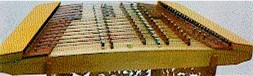 Yangqin
(
Yangqin
( )
is a Chinese hammered dulcimer with a near-squared soundboard. The
instrument is very similar to Santur, played with two bamboo sticks. )
is a Chinese hammered dulcimer with a near-squared soundboard. The
instrument is very similar to Santur, played with two bamboo sticks.
Note:
In Chinese, most of the stringed instruments are called "qin"()
with few exceptions that are named differently, for instance,
pipa()
and erhu()however,
erhu is often called Huqin ).
references:
|


 Kong
Hou)
Kong
Hou)