 |
 |
|

|
|
|

|
 )
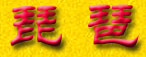
consists of two Chinese characters symbolizing two playing techniques
(denoted as "Tan" and "Tiao" today) while their pronunciations
p'i and p'a are imitations of the sounds produced accordingly.
The latter fact is however not often mentioned in the literatures about
the pipa (see Note )
consists of two Chinese characters symbolizing two playing techniques
(denoted as "Tan" and "Tiao" today) while their pronunciations
p'i and p'a are imitations of the sounds produced accordingly.
The latter fact is however not often mentioned in the literatures about
the pipa (see Note  ) )
The
historical development of the pipa has been a progressive process
from its very beginning with few major fusions. The earliest Chinese
written texts about the pipa dated back at least to the second
century BC. For instance, Xi Liu of the Eastern Han Dynasty (25-220
AD) described in his book, The Definition of Terms - On Musical
Instruments, that the name of the instrument pipa originally
referred to two finger techniques. The two Chinese characters p'i
and p'a stood originally for the two movements, i.e. plucking
the strings forwards and backwards, respectively. It is
commonly known now that the term "pipa" used to be the generic
name for all pluck-string instruments of the ancient times. For
instance, in the Qin Dynasty (222-207 BC), there had been a kind of
plucked-instrument, known as xiantao, with a straight neck
and a round sound-body played horizontally, which is considered one
of the predecessors of the pipa. In the preface to his verse
Ode to Pipa, Xuan Fu of the Jin Dynasty (265-420 AD) wrote:
"...the pipa appeared in the late Qin period. When the
people suffered from being forced to build the Great Wall, they played
the instrument to express their resentment". By the Han Dynasty
(206 BC -- 220 AD), the instrument developed into its form of four strings
and twelve frets, plucked with fingernails and known as pipa
or qin-pipa |
 Hu
stands for "foreign" in Chinese), which was played horizontally
with a wooden plectrum (see the picture below for the Tang Dynasty pipa
player). During the early Tang Dynasty, foreign music became very popular.
A fusion of the original Chinese pipa and the "Hu pipa"
took place such that the instrument gradually became what the present
pipa looks like toward the middle of the Tang Dynasty (see the
above Fig.1
[1]-[4] and the Note Hu
stands for "foreign" in Chinese), which was played horizontally
with a wooden plectrum (see the picture below for the Tang Dynasty pipa
player). During the early Tang Dynasty, foreign music became very popular.
A fusion of the original Chinese pipa and the "Hu pipa"
took place such that the instrument gradually became what the present
pipa looks like toward the middle of the Tang Dynasty (see the
above Fig.1
[1]-[4] and the Note  on the right panel). Meanwhile the playing method has been developed and
repertoire increased. One of the greatest developments was that the left
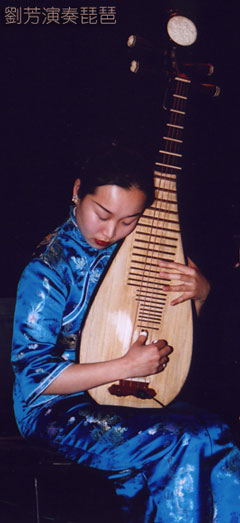
hand became totally free by holding the instrument vertically, i.e. the
pipa rests on the thigh of the instrumentalist in an upright
position, and was played vertically with five fingers of the right hand
instead of horizontally with a plectrum (see the photo at the top of this
page).
on the right panel). Meanwhile the playing method has been developed and
repertoire increased. One of the greatest developments was that the left
hand became totally free by holding the instrument vertically, i.e. the
pipa rests on the thigh of the instrumentalist in an upright
position, and was played vertically with five fingers of the right hand
instead of horizontally with a plectrum (see the photo at the top of this
page).
The Tang pipa (Fig. 1[3]) was larger than the modern instrument. It usually had four or five strings and fewer frets (compared to the present day pipa). Probably influenced by the Hu pipa, the Tang pipa was often played with a wooden plectrum, a technique still used by its Japanese descendent, the biwa. Since the mid Tang Dynasty, and particularly since the Song Dynasty (960-1279), the instrument was gradually developed into the present form of a lute played with fingernails, while the techniques with the plectrum were totally abandoned. The strings of the instrument were made of silk. Musicians used their real nails of the right hand to pluck the strings. An exception to this is the Nanguan pipa which is popular in Fujian Province (South-East China) and Taiwan in a particular kind of traditional music called Nanguan which can be traced back to at least the Song Dynasty. Pipa players in the Nanguan tradition play the pipa horizontally and use one piece of plectrum just like the Tang pipa.
The
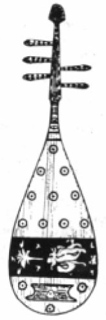
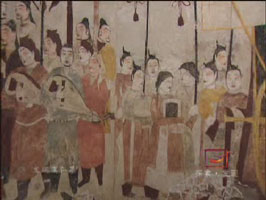
above picture is from the Jin Dynasty (265-420 AD).
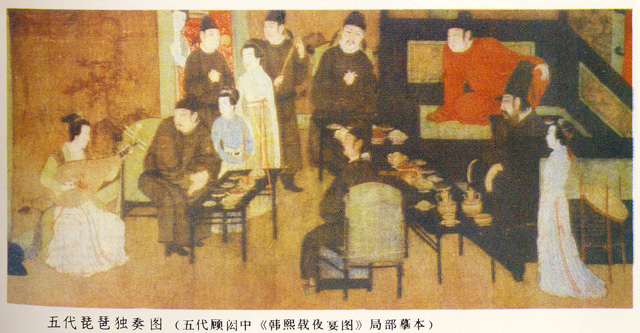
The above is a painting from the "Five Dynasty" (907-960 AD) depicting Tang pipa playing Another big change (fusion) occurred to the pipa during the first half of the last century: the traditional pipa with silk strings and pentatonic tuning has developed into the modern pipa with steel strings and chromatic tuning (by increasing the number of frets). The modern instrument is half-pear-shaped, with a short, bent neck, and has 30 frets which extend down the neck and onto the soundboard, giving a wide range and a complete chromatic scale. The usual tuning is A - E - D - A (La - Mi - Re - La). Since early last century, steel strings began to be used by some musicians while most still kept using silk strings. Since the 1950s, the making of the pipa has become standardized in measure and the strings are made of steel wrapped with nylon. Thus using the real nail becomes almost impossible. Instead, a little plectrum (or fake nail) is attached to each finger of the right hand. The plectrums are usually made of turtle shell or special plastics. Notation for the pipa combines symbols for pitch (Kung-ch'e system) with abbreviated characters for special finger techniques. Today, a simplified version of music scores are commonly used in which numbers representing pitches and symbols representing finger techniques are used. Meanwhile, the standard Western music score has been used increasingly because it has advantages in ensemble pieces and in particular for pipa concertos There was a huge repertoire of pipa music in Chinese history, particularly during the Tang dynasty. But most of the pieces were lost. Fortunately, there are precious pipa pieces handed down from one generation to another by individual artists and scholars. Some pieces have been preserved in Japan and other musical scores were discovered along the Silk Road in Gansu Province, China, around 1900. These musical notations, known as the Dunhuang scores from the Tang Dynasty (7-9th century) triggered great concern and interest within China as well as abroad. However, they remained a mystery until the early 1980s, when the scholar, Prof. Ye Dong from the Shanghai Conservatory of Music, successfully "decoded" 25 of the pieces. The beauty and elegance of these pieces has thus first been revealed to the public after having slept for a thousand years. Pipa music has been loved by Chinese people through the centuries. During the Ming (1368-1644) and Qing (1645-1911) dynasties, various pipa schools with different styles flourished in the South, centered in Wuxi, Suzhou and Shanghai, and the North, centered in Beijing. The development of finger techniques for both hands achieved a high standard by the masters from each school. The present day pipa techniques are mostly the fusion of those different schools. Now the pipa is one of most popular instruments in China. Many of the compositions that make up the traditional repertoire, which were handed down from generation to generation through individual artists and scholars, date back hundreds of years, while others are part of a body of compositions that are dynamic and growing. In more recent times, composers have explored the possibilities for the pipa and other Chinese and Western instruments, even with orchestra. Nowadays, there are a number of celebrated pipa concerti.
The
playing technique consists of the right hand fingers
plucking the strings and the left hand fingers touching the strings
in a variety of ways to create melodies, ornaments and special effects.
The fingers that pluck the strings move outwards, just the opposite
to guitar techniques. The frets are pretty high, which allows the
string to be pushed, twisted, and pressed. There are over 60 different
techniques that have been developed through the centuries.
The pipa's technique is characterized by spectacular finger dexterity
and virtuosic programmatic effects. Rolls, slaps, pizzicato, harmonics,
and noises are often combined into extensive tone-poems vividly
describing famous battles or other exciting scenes, such as the
Ambush
(see the demo video #2 below). This type is called "wu qu"
(martial style). This example describes the decisive battle fought
in the second century BC between Chu (Xiang Yu) and Han (Liu Bang).
The instrument is also capable of more lyric effects, in the category
of "wen qu" (civil styles) such as the famous tunes
"Fei Hua Dian Cui" (Swirling snow decorates the
evergreen, see the demo video #1 below) or Sai
Shang qu (Songs from the other side of the
border). The former uses a scene in nature as metophor to
describe human feeling. The latter is said to represent the sorrowful
song of a Han dynasty (206 BC - 220 AD) noblewoman, who was compelled
for political reasons to marry a barbarian prince. This story
appears in several versions connected with the origin of the pipa.
There are also a lot of written texts and famous poems about the
pipa music played by virtuoso performers in history. For instance,
the following comments can be found in the texts from the Tang
Dynasty (618 - 907) describing the intensity of the Ambush played
by artists of that time : "... as if thousands of warriors
and horses are roaring on the battle field, as if the earth is
torn and the sky is falling". In his poem, the Pipa
Song, Bai Juyi, one of the leading poets in the Tang
Dynasty, described vividly the pipa music performed by an artist:
"... The thicker strings rattled like splatters of sudden
rain, the thinner ones hummed like a hushed whisper. Together
they shaped strands of melody, like larger and smaller pearls
falling on a jade plate." DEMO: Two typical styles of traditional pipa repertoire
|
|
An introduction to traditional and classical music from China
Some further topics:
|
|
Online
available: |


[Top] [Discographies - CD albums] [CD order form] [News] [Audio and video clips]



 (see
Fig.1[
(see
Fig.1[ )
whereas the name pipa specifically referred to a new version
in the same family of instruments, which developed as follows:
)
whereas the name pipa specifically referred to a new version
in the same family of instruments, which developed as follows: 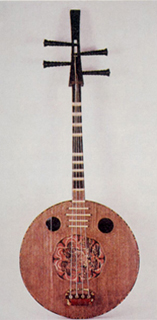

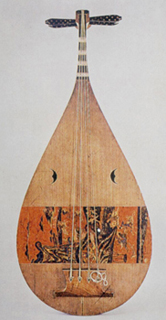
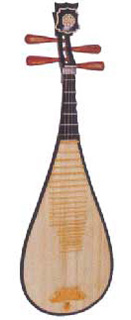


 Demo
#1: Wen qu (civil style or lyrical style)
Demo
#1: Wen qu (civil style or lyrical style) Liu
Fang concert live in St. Petersburg & the reportage from Russian
TV
Liu
Fang concert live in St. Petersburg & the reportage from Russian
TV or
or  in
the earliest documents, where
the
in
the earliest documents, where
the  (wood)
refers to the material the pipa was made of, and the
(wood)
refers to the material the pipa was made of, and the  is a symbol for "the hand/fingers",
implying "action" with fingers (thus finger techniques),
whereas the two symbols
is a symbol for "the hand/fingers",
implying "action" with fingers (thus finger techniques),
whereas the two symbols  and
and  on the left side of the characters are
used here simply to borrow their pronunciations - pi
and pa. In another words, they stand there in the
formation of the two characters for the pipa simply
because their pronunciation sounds similar to the two sounds
produced by the two finger techniques on the pipa. Later on
(around the third century), the written characters for pipa
have
been standardized
as
on the left side of the characters are
used here simply to borrow their pronunciations - pi
and pa. In another words, they stand there in the
formation of the two characters for the pipa simply
because their pronunciation sounds similar to the two sounds
produced by the two finger techniques on the pipa. Later on
(around the third century), the written characters for pipa
have
been standardized
as  is the common root for the names of
the ancient string instruments
is the common root for the names of
the ancient string instruments  )
and
)
and  ).
). )
and
zheng (
)
and
zheng ( )
is often called
)
is often called 


