Though
also used in ensembles, the pipa is primarily a solo instrument like
a guitar. The pipa
music repertoire consists of ancient Chinese master pieces whose composers
are mostly anonymous, and the contemporary works by composers with
both Chinese and western musical influences.
Traditional
Chinese music generally refers to the compositions that
have stood the test of time and are likely to exists "so long
as man can breathe or eyes can see". However, when talking about
"traditional Chinese music", just like Chinese, it is helpful
to keep in mind that China is made up of many peoples, with each more
or less having their own tradition and music.
Generally
speaking, there are two kinds of traditions, namely classical traditions
and folk traditions. Music from the 'classical tradition' refers to
'sophisticated' music (or classical music) as opposed to folkloric
music or music to dance. The major parts of classical traditions can
be dated back several hundreds year, with some even over thousand
years in Chinese history. It is mainly an oral tradition from generation
to generation; there were written scores combining numbers and symbols
representing pitch and finger techniques. However it is almost impossible
to play directly from the score without learning the from a teacher.
Traditional
music in the classical sense is intimately linked to poetry and to
various forms of lyric drama and is more or less poetry without words.
In the same manner as poetry, music sets out to express human feelings,
soothe suffering and bring spiritual elevation. Their interpretation
requires not only perfection of pipa playing techniques, but also
(and more) relies on the level of spiritual development of the interpreters
in order to deliver the deep meaning and inner feeling of the master
pieces (see Interview
with Liu Fang).
The
folk melodies are rarely used unchanged for pipa concerts, but have
been a constant source of inspiration for contemporary composition.
Most contemporary music for the pipa takes advantage of advanced pipa
techniques and music theories. The sources of inspiration are rich
and are mostly traditional and folkloric themes. In fact, many pieces
simply modify, transcribe or rearrange those melodies, so successfully
such that some of the excellent works have been regarded as part of
the growing classical repertoire, for instance the famous Dance
of Yi People composed by Wang Hui-Ran. The repertoire is further
expended by pieces composed or arranged for duets or trios in which
the pipa is accompanied by cello, guitar, flute, piano or zheng. There
are also pieces for pipa
and orchestra. Famous pipa concerti are Little sisters on the
grassland (Liu Dehai and Wu Zhuqiang), Ghost Opera (Tan Dun), Mulan
(Gu Guanren), and The king takes off his armour (arranged from traditional
solo piece by Zhou Long, an different version by Yang liqin). Note
that are several new
works for pipa concertos in recent years in China.
Once
the pipa was introduced to the west, its music began to fuse with
western classical and contemporary traditions. More and more composers
with western music education background begin to explore new possibilities
with the pipa, such as USA-based composers,
Tan Dun, Zhou Long, Chen Yi. Recently, Melissa Hui, an accomplished
Canadian composer, composed one piece for pipa and string quartet
and another piece for pipa and nine western instruments, both having
been premiered by Liu Fang in 1999 and 2002. Quebec composers Simon
Bertrand and Hugue Leclair have all composed for pipa and string quartet
and pipa concerto, and having been premiered
by Liu Fang.
In
2001 , the internationally renowned composer R. Murray Schafer composed
and produced opera entitled "The
Palace of the Cinnabar Phoenix" for 5 opera singers,
20 instrumentalist including Chinese pipa, guzheng and erhu, a women
chore, and a team of puppet player. The premiere of this great work
(where Liu fang performed both pipa and guzheng) turned out to be
magical, and highly acclaimed in the media and by the audience. This
work will be presented soon again in a natural environment on a lakeshore
near Toronto from August 31 to September 9, 2006 in
8 spectacles.
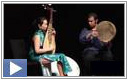
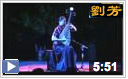
The following demo is for Guzheng
(0 - 1:40) and pipa (1:40-4:12)
2.
Guzheng Music
Liu Fang plays Guzheng
Guzheng
has been closely related with guqin
(7-stringed zither) in the sense that they belong to the same zither
family, but has been enjoyed much greater popularity than the guqin
throughout its history of over 2000 years, mainly because the guzheng
is a folk-rooted instrument from its origin, and with the time it has
developed among folk traditions from various parts of China. Whereas
guqin is highly regarded as the most representative of classical
music genre in China, performed by scholars, high society ladies
and amateurs, and thus belongs to a small "minority" of the
elite society in China's historical past. On the contrary, guzheng has
been always a folk music instrument. Solo guzheng music has always strong
local flavour - every region has its own style, in a way like local
dialects of the Chinese language. Thus there are Henan style, Chaozhou
style, Shandong Style, Zhejiang style, Kejia style etc. Since the last
century there are increasing number of solo guzheng compositions with
more or less western influences (commonly known as "contemporary
music"). Meanwhile, some of the classical guqin music has been
transcribed successfully for guzheng. It is now one of the most versatile
instruments from China that can play both classical and folk styles.
(More ...)
"If
the audience is not moved by the music, particularly if it is a masterpiece
from the guqin core repertoire, it is usually the player's fault and not
the listener's." - Prof. Li Xiangting, internationally-reknowned
Chinese guqin master.
The same is true for all kinds of master pieces
from the traditional repertoire!





 A
brief introduction to Chinese Traditional Music
A
brief introduction to Chinese Traditional Music  The following demo is for Guzheng
(0 - 1:40) and pipa (1:40-4:12)
The following demo is for Guzheng
(0 - 1:40) and pipa (1:40-4:12)